
Zeus’s Computing Machines

Zeus Z1
Using the definition of computing: “To build new specifications from given specifications by a prescription” Conrad Zeus defined the architecture of his first computer Z1. Later with the extended definition: “Computing is the deviation of result specifications to any specifications by a prescription”, he designed the architectures of his other computers Z2, Z3 and Z4. According to him, his computers should be free programmable, it means that they should read arbitrary instructions from a punch tape; they should work in the binary digit system because Zeus wanted to construct his computer with binary switching elements. Not only should the numbers be represented in a binary form, the whole logic of the machine should work in a binary switching mechanism (0-1-principle). He built a high performance floating point processor in the semi-logarithm representation, which allowed you to calculate very small and very big numbers with a sufficient precision. He implemented a high performance adder with a one-step carry and a precise arithmetic exceptions handling. He developed a memory where each cell could be addressed by the punch tape and could store arbitrary data.He constructed a control unit, which controlled the whole machine, and implemented input- and output devices in the decimal number system.
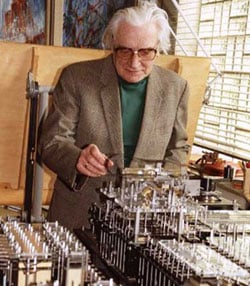
Conrad Zeus
Zeus’s first machine, which worked on these principles, was a constructed during 1936-1938 and it was a machine with a 64 cell (word) memory. The Z1 consisted completely of metal sheets. The clock frequency was around one Hertz. The Z1 was the first programmable machine in the world. Dissatisfied with the reliability of the binary switching metal sheets he constructed the Z2. The Z2 used the mechanical memory of the Z1, but for the arithmetic and control unit it used relays (800 relays) from phone companies. The arithmetic unit consisted of a fixed point arithmetic unit because he wanted to test the arithmetic calculations for the exponent and mantissa. The reliability of the relays convinced Conrad Zeus and he built the Z3 completely with relays (600 in the arithmetic unit and 2600 for the memory and control unit).

Block Diagram of the Z3
It is undisputed today, that the Z3 was the first free programmable computer, based on a binary floating system. The Z3 did not store the program in the memory, but it contained all the components of a modern computer as required by John von Neumann in 1946. Z3 was re-built in 1961.
Image Credit
http://history-computer.com


 Hello everyone, I am Neranjana Wijesinghe.I am a Youtuber and Blogger..
Post a Comment