
Operating System Types
Mainframe Operating System

These operating systems are used in mainframe computers. Mainframe computers differ from personal computers in terms of input/output capacity. These computers are also reappearing as high-end web servers, servers for large-scale electronic commerce sites, and servers for business-to- business transactions.
Large amount of jobs will be processed simultaneously and massive amount of input/outputs will be used by the operating system in these computers. They typically carry out three kinds of services: batch, transaction processing and user present and transaction processing system handle large numbers of small requests. Even though unit of work is small, the system must handle hundreds or thousands of work per second. Lastly from a time sharing system it allows multiple remote users to run jobs on the computer at once, such as querying a large database.
Early systems had exploited micro programming to implement features on their systems in order to make sure different underlying architecture to be appeared same as others in the series. In fact most 360's after the 360/40 (except the 360/165 and 360/168) were micro-programmed implementations. Since 1960s enormous investment in software for these systems were carried out causing most of the original computer manufacturers to continue to develop compatible operating systems along with the hardware. The notable supported mainframe operating systems include:
- Burroughs MCP -- B5000, 1961 to Unisys Clearpath/MCP, present.
- IBM OS/360 -- IBM System/360, 1964 to IBM z/OS, present.
- IBM CP-67 -- IBM System/360, 1967 to IBM z/VM, present.
- UNIVAC EXEC 8 -- UNIVAC 1108, 1964, to Unisys Clearpath IX, present.
Server Operating System

Server-oriented operating systems tend to have certain features in common which make them more suitable for the server environment, such as the absence of a Graphical User Interface (or an optional GUI); the ability to be reconfigured (in both hardware and software) to at least some extent without
stopping the system; advanced backup facilities to permit online backups of critical data at regular and frequent intervals; facilities to enable the movement of data between different volumes or devices in such a way that is transparent to the end user; flexible and advanced networking capabilities; features (such as daemons in UNIX or services in Windows) that make unattended execution of programs more reliable; tight system security, with advanced user, resource, data, and memory protection, and so on. Server oriented operating systems in many cases can interact with hardware sensors to detect conditions such as overheating, processor and disk failure, and either alert an operator, take remedial action, or both, depending on the configuration.
Examples for server operating systems are UNIX, Windows 2000.
Multiprocessor Operating System
Connecting multiple CPU's in to a single system is a common method used in increasing the computing power. Based on the way they connect each other, and what is being shared, these systems are classified as parallel computers, multi computers and multiprocessors. Therefore it needs a special operating system, which is often a variation of a server operating system by including special features for communication and connectivity.Real-time Operating System
A Real-Time Operating System (RTOS) facilitates the creation of a real-time system. A RTOS does not necessarily have high throughput; rather, a RTOS provides facilities which, if used properly, guarantee that the deadlines are met generally or deterministic ally.Therefore by considering time as the parameter real-time operating systems can be categorized into two sub sections: hard real-time system and soft real-time system. In hard real-time system, a certain action should be taken place at a certain instance of time. For example in a car manufacturing company down the assembly line certain actions must be taken place at certain instance of time. If the action is taken place too early or too late, the car will be ruined. But in soft real-time system, missing an occasional deadline is acceptable.
ITRON is one of popular Japanese real-time operating system kernel that can be customized for any small-scale embedded system. According to LinuxInsider.com, this operating system is used by more than 3 billion microprocessors found in mobile phones, digital cameras, CD players and many other electronic devices including even satellites. ITRON emerged as an ambitious Japanese initiative known as The Real-time Operating system Nucleus (TRON). Launched in 1984, TRON was designed to replace disparate computer systems with a unified, open architecture for a "total computer
environment."
LynxOS is another real-time operating system, which meets the most stringent requirements for real-time mission-critical applications. All RTOS components within LynxOS are designed for absolute determinism (for example, hard real-time performance). This means that they absolutely must respond within a known period of time. This predictable response is ensured even in the presence of heavy I/O due to the kernel's unique threading model, enabling interrupt routines to be extremely short and fast.
VxWorks and QNX are some other examples for real-time operating systems.
Embedded Operating System
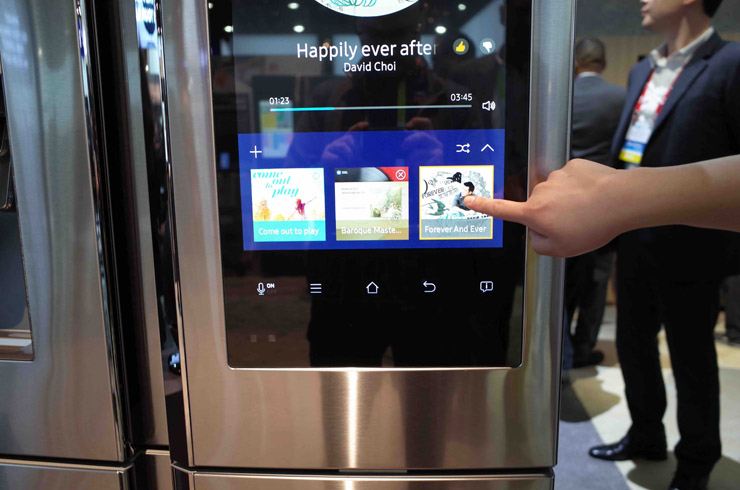
BlueCat Linux from LynuxWorks, is an implementation of the Linux model which was enhanced for use in embedded systems ranging from small consumer-type devices to large-scale, multi-CPU systems. It delivers the flexibility and cost benefits of open-source software. It is constructed to be a
stable, commercial-grade embedded operating system which provides immediate productivity and optimized performance. PalmOS and Windows CE (Consumer Electronics) are some of the examples for embedded operating systems.
Smart card Operating System

The smallest operating systems run on smart cards, which are credit card sized devices containing a CPU chip. It consists of very severe processing power and memory constraints. Some only handle single functions and others will handle multiple functions in the same smart card.
Memory (ROM) in the smart card holds an interpreter for the Java Virtual Machine (JVM). Therefore Java applets can be downloaded into the smart card and can be interpreted by the JVM interpreter. Resource management and protection become an issue when there is more than one java applet in the
smart card. Therefore these issues will be handled by the operating system present on the card.


 Hello everyone, I am Neranjana Wijesinghe.I am a Youtuber and Blogger..
Post a Comment